rlauxe
Developer Notes
09/25/2026
- Developer Notes
- Getting Started
- UML
- Code Coverage (Lines of Codes)
- Miscellaneous Internal Notes
Getting Started
Prerequisites
- A git client that is compatible with GitHub.
- Java 21+. Install as needed, and make it your default JVM when working with rlauxe.
- The correct version of Gradle and Kotlin will be installed when you invoke a gradle command.
- You need internet access to download the dependencies.
Download the git repository
cd <devhome>
git clone https://github.com/JohnLCaron/rlauxe.git
cd rlauxe
Build the library
To do a clean build (no tests):
cd <devhome>/rlauxe
./gradlew clean assemble
Normally rlauxe-viewer keeps the current rlauxe library inside its own repo. However, if the library has changed on GitHub and you need to rebuild it:
cd <devhome>/rlauxe
git fetch origin
git rebase -i origin/main
Then rebuild the code:
./gradlew clean assemble
Run tests
Set the test data directory
Before running the tests, go to the source file core/src/testFixtures/kotlin/org/cryptobiotic/rlauxe/TestUtils.kt. At the top of the file, change the line:
val testdataDir = "/home/stormy/rla"
to some directory on your system. Make sure the directory exists.
Run the core tests using gradle
To build the complete library and run the core tests:
    cd <devhome>/rlauxe
    ./gradlew clean assemble
    ./gradlew core:test
To run a subset of tests in cases:
    cd <devhome>/rlauxe
    ./gradlew :cases:test --tests "org.cryptobiotic.create.*"
Using IntelliJ
We recommend using the IntelliJ IDE if you plan on doing Java/Kotlin coding, or even if you are just building and running.
- Make sure the prerequisites are satisfied, as above.
- Download the git repository as above.
- Install IntelliJ. The (free) community version probably works fine, but an individual license for the Ultimate Edition is well worth it.
Start up IntelliJ, and in the top menu:
- File / New / “Project from existing sources”
- In the popup window, navigate to devhome/rlauxe and select that directory
- Choose “Import project from existing model” / Gradle
IntelliJ will create and populate an IntelliJ project with the rlauxe sources.
To build the library, from the topmenu: Build / Build Project (Ctrl-F9)
To run the core tests, from the left Project Panel source tree, navigate to the core/src/test/kotlin/org/cryptobiotic/rlauxe directory, right click on the directory name, choose “Run tests in …”. If that menu option isn’t shown, check if you’re in the main source tree instead of the test source tree.
To run individual tests, go to the test source; IntelliJ will place a clickable green button in the left margin (next to @Test) wherever there is a runnable test.
There’s lots of online help for using IntelliJ.
Modules
- cases: code to create case studies
- core: core library
- docs: documentation
- libs: local copy of raire-java library
- plots: code to generate plots used in the documentation
Generate Test Cases
build the uberjars:
cd <devhome>/rlauxe
./gradlew assemble uberjar
look in cases/build/libs to see what the latest library build version is, for example rlauxe-cases-0.10.4.3-uber.jar and set an env variable, eg for bash:
export CASES_UBER_LIBRARY=rlauxe-cases-0.10.4.3-uber.jar
echo $CASES_UBER_LIBRARY
The “uber jar” contains the cases and core codes, as well as all of their dependencies.
Dont use “~” in quoted file paths.
For the Belgium 2024 test case
The repo contains the input needed for belgium2024. To create the data:
java -classpath cases/build/libs/$CASES_UBER_LIBRARY org.cryptobiotic.rlauxe.cli.CreateCaseData \
    -case belgium -toptopdir "/home/you/wherever/cases/belgium2024"
- substitute your own output “topdir” directory
Use java -jar viewer/build/libs/viewer-uber.jar -BelgiumContests to view this case.
See here.
For the Boulder 2024 test case
The repo contains the needed input for boulder024. To create the data:
java -classpath cases/build/libs/$CASES_UBER_LIBRARY org.cryptobiotic.rlauxe.cli.CreateCaseData \
    -case boulder2024 -toptopdir "/home/you/wherever/cases/boulder2024" -type oa
which will create a OneAudit election. To create a CLCA election, use the flag “-type clca”
For Colorado elections using auditcenter
The repo does not contain the test data input for Colorado. Clone the following git repository:
git clone https://github.com/nealmcb/auditcenter
For Colorado 2020 General elections
java -classpath cases/build/libs/$CASES_UBER_LIBRARY org.cryptobiotic.rlauxe.cli.CreateCaseData \
    -case corla2020 -toptopdir "/home/you/wherever/cases/corla2020" \
    -auditcenter "/local/github/nealmcb/auditcenter"
- clone auditcenter and place in your local directory.
- substitute your own “toptopdir” directory where the data will be written.
To see the data in the viewer, see here
To run the Colorado 2020 election with cvrs from https://votedatabase.com, see here. Then use
java -classpath cases/build/libs/$CASES_UBER_LIBRARY org.cryptobiotic.rlauxe.cli.CreateCaseData \
    -case corla2020withCvrs -toptopdir "/home/you/wherever/cases/corla2020withCvrs" \
    -auditcenter "/local/github/nealmcb/auditcenter" \
    -input "/home/you/wherever/votedatabase/cvr/Colorado"
Other Colorado elections in auditcenter
java -classpath cases/build/libs/$CASES_UBER_LIBRARY org.cryptobiotic.rlauxe.cli.CreateCaseData \
    -case casename -toptopdir "/home/you/wherever/cases/casename" \
    -auditcenter "/local/github/nealmcb/auditcenter"
where casename can be
- corla2020 = 2020 General; cvrs are simulated
- corla2020withCvrs = 2020 General using votedatabase for the CVRs
- corla2022p = 2022 Primary; cvrs are simulated
- corla2024 = 2024 General; cvrs are simulated
- corla2026p = 2026 Primary; cvrs are simulated
- corla2026pm = 2026 Primary with multicounty contests merged back together where needed; cvrs are simulated
- corla2026Pcvrs = 2026 Primary with 4 counties that we have the CVRS for
| corla2020 | corla2020withCvrs | corla2022p | corla2024 | corla2026p | corla2026pm | corla2026Pcvrs |
For the Georgia 2026 primary test case
java -classpath cases/build/libs/$CASES_UBER_LIBRARY org.cryptobiotic.rlauxe.cli.CreateCaseData \
    -case ga26p -topdir "/home/you/wherever/cases/ga2026Primary" \
    -input "/home/you/wherever/github/nealmcb/rla-review-arlo/2026-05-19-primary/extracted"
will create a OneAudit election.
For the San Francisco 2024 test case
The repo does not contain the test data input for San Francisco. Download
Create the top directory for this case (eg $testdataDir/cases/sf2024/), and put the downloaded zip file in it.
Then run:
java -classpath cases/build/libs/$CASES_UBER_LIBRARY org.cryptobiotic.rlauxe.cli.CreateCaseData \
    -case sf2024 -toptopdir "/home/you/wherever/cases/sf2024" --cvrExport
to build the cvrExport.csv file, which will be written to topdir. This only needs to be done one time.
To generate the sf2024 election data:
java -classpath cases/build/libs/$CASES_UBER_LIBRARY org.cryptobiotic.rlauxe.cli.CreateCaseData \
    -case sf2024 -toptopdir "/home/you/wherever/cases/sf2024"
will create a OneAudit election in “/home/you/wherever/cases/sf2024/oa”. To create a CLCA election, add the flag “-type clca” which will create a Clca election in “/home/you/wherever/cases/sf2024/clca”
If you want to control where the election is placed, use
java -classpath cases/build/libs/$CASES_UBER_LIBRARY org.cryptobiotic.rlauxe.cli.CreateCaseData \
    -case sf2024 -toptopdir "/home/you/wherever/cases/sf2024" \
    -output "/home/you/wherever/" -type [clca | oa]
will create a type election in “/home/you/wherever”, taking the cvrs from “/home/you/wherever/cases/sf2024”.
rlauxe viewer
Download the rlauxe-viewer repo and follow the instructions to view Audit Records and run audits on them, for example on any of the test cases.
Caveat Emptor: The serialization formats are undergoing rapid changes, with no backwards compatibility (yet). Expect that if you download a new version of the library, you may have to regenerate any audit records (including tests case data), before viewing them.
Quaeso ignosce mihi peccatum meum: We are now using semantic versioning (with a leading 0 to indicate a prerelease): eg “0.10.4.2” = 0.MAJOR.MINOR.PATCH. The data format is rapidly changing in incompatible ways; when it does, the major version will increment. You will have to regenerate any data you have. The case study data can now be regenerated from the command line, see Getting Started. Mea culpa, mea culpa, mea maxima culpa.
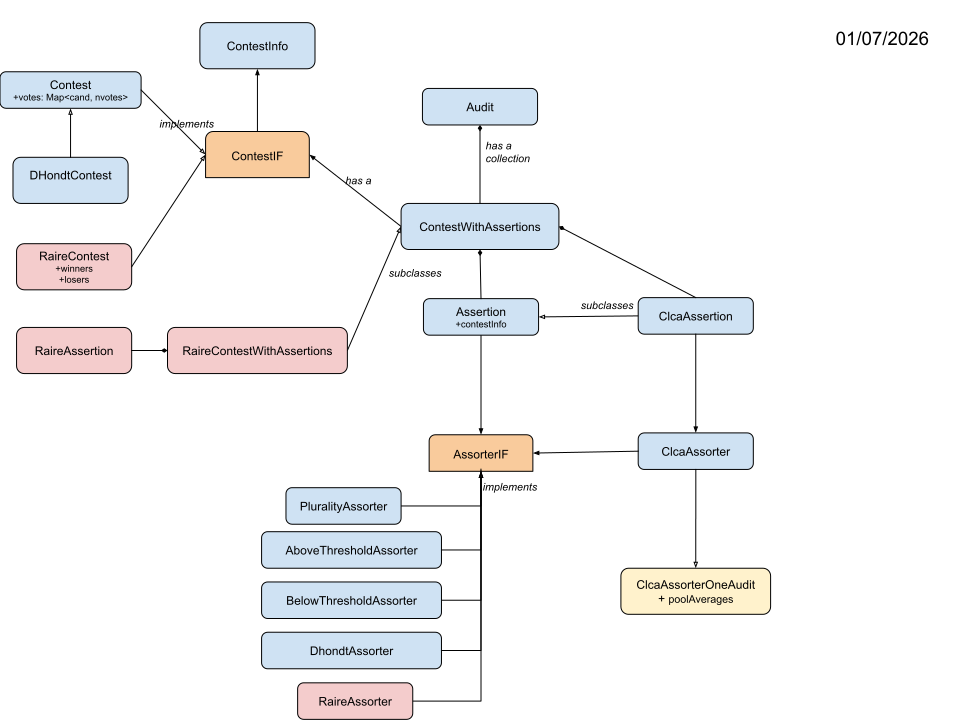
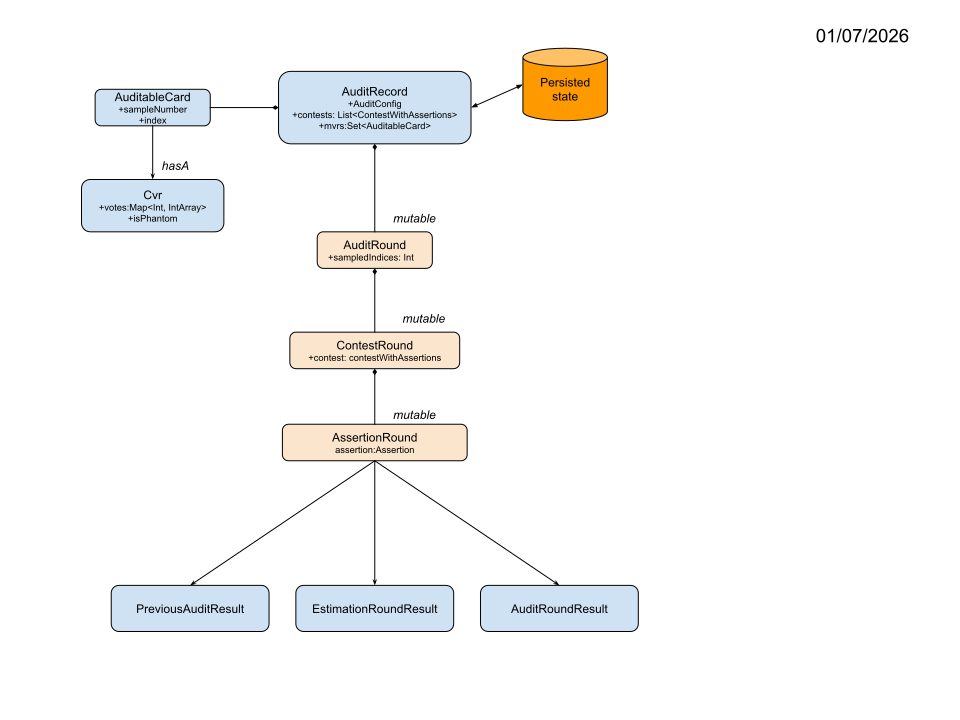
UML
last changed: 01/07/2026
Code Coverage (Lines of Codes)
core test coverage
| date | pct | cover/total LOC |
|---|---|---|
| 11/20/2025 | 84.0 % | 5602/6667 |
| 11/25/2025 | 85.2 % | 5229/6136 |
| 11/28/2025 | 85.9 % | 5188/6039 |
| 11/29/2025 | 86.3 % | 5208/6034 |
| 11/30/2025 | 86.7 % | 5255/6058 |
| 12/04/2025 | 85.0 % | 5327/6265 |
| 12/10/2025 | 80.5 % | 5338/6634 |
| 12/13/2025 | 82.8 % | 5341/6449 |
| 12/18/2025 | 83.9 % | 5332/6357 |
| 12/23/2025 | 83.9 % | 5393/6431 |
| 01/07/2026 | 84.5 % | 5344/6327 |
| 01/16/2026 | 87.5 % | 5417/6190 |
| 01/18/2026 | 90.2 % | 5677/6294 |
| 01/27/2026 | 87.6 % | 6021/6871 |
| 01/27/2026 | 87.8 % | 5847/6658 |
| 02/13/2026 | 87.2 % | 6116/7014 |
| 02/14/2026 | 87.8 % | 6174/7034 |
| 02/19/2026 | 89.1 % | 6251/7017 |
| 02/24/2026 | 90.2 % | 6252/6934 |
| 03/02/2026 | 90.6 % | 6427/7090 |
| 03/03/2026 | 91.5 % | 6510/7116 |
| 03/03/2026 | 90.1 % | 6497/7208 |
| 03/27/2026 | 89.4 % | 6189/6919 |
| 03/30/2026 | 90.5 % | 6355/7022 |
| 05/20/2026 | 81.3 % | 6816/8383 |
| 05/20/2026 | 86.7% | 7212/8323 |
| 07/08/2026 | 79.9% | 7796/9752 |
| 07/09/2026 | 81.3% | 7650/9407 |
| 07/10/2026 | 78.6% | 7437/9460 |
| 07/11/2026 | 83.0% | 7819/9426 |
| 08/19/2026 | 83.1% | 7820/9409 |
core + cases test coverage
| date | pct | cover/total LOC |
|---|---|---|
| 07/11/26 | 70.1 % | 10502/14972 |
| 08/19/26 | 75.0 % | 10974/14632 |
core + cases + CreateCases test coverage
Include TestCreateCaseData
| date | pct | cover/total LOC |
|---|---|---|
| 07/08/26 | 72.5 % | 10673/14726 |
| 07/09/26 | 78.5 % | 11592/14769 |
| 07/10/26 | 75.4 % | 11140/14777 |
| 07/11/26 | 77.2 % | 11527/14936 |
Miscellaneous Internal Notes
There are two kinds of Contests, Regular (with votes) and Irv (with VoteConsolidator’s). There are two kinds of Audits, Polling and Clca. If a Clca has pools, then it’s a OneAudit with OneAuditClcaAssorter’s
| audit | contest | assorters |
|---|---|---|
| polling | regular | PluralityAssorter |
| polling | irv | RaireAssorter |
| clca | regular | ClcaAssorter |
| clca | regular | ClcaAssorterOneAudit |
| clca | irv | ClcaAssorter with RaireAssorter |
| clca | irv | ClcaAssorterOneAudit with RaireAssorter |
ContestIF
    Contest
    DhondtContest
    IrvContest

ContestWithAssertions
    hasa ContestIF
    hasa List<PrimitiveAssorter>
    (if Clca) hasa List<ClcaAssorter>
    (if OneAudit) hasa List<ClcaAssorterOneAudit)

->subclass RaireContestWithAssertions
    hasa IrvContest
    hasa List<RaireAssertion>
    (if Clca) hasa List<ClcaAssorter>
    (if OneAudit) hasa List<ClcaAssorterOneAudit)

AssorterIF (aka PrimitiveAssorter)
    PluralityAssorter
    AboveThreshold
    BelowThreshold
    DhondtAssorter
    RaireAssorter
        hasa RaireAssertion

ClcaAssorter
    hasa AssorterIF

->subclass ClcaAssorterOneAudit

Assertion
    hasa AssorterIF

->subclass ClcaAssertion
    hasa ClcaAssorter
Documents
README
docs/SamplePopulations.md
docs/Verification.md
docs/BettingRiskFunctions.md
docs/OneAuditUseCases.md
docs/AlphaMart.md
    (https://docs.google.com/spreadsheets/d/1bw23WFTB4F0xEP2-TFEu293wKvBdh802juC7CeRjp-g/edit?gid=662624429#gid=662624429)
    (https://docs.google.com/spreadsheets/d/1bw23WFTB4F0xEP2-TFEu293wKvBdh802juC7CeRjp-g/edit?gid=1185506629#gid=1185506629)
docs/ClcaErrors.md
docs/CaseStudies.md

docs/papers/papers.txt
docs/Developer.md
docs/Verification.md
docs/CaseStudies.md
    (Corla.md)
docs/Raire.md
docs/DHondt.md
maybe: docs/Attacks.md docs/AuditRecord.md docs/RlauxeSpec.md docs/VerifierSpec.md
not:
docs/Clca.md
docs/GeneralizedAdaptiveBetting.md
docs/RlaOptions.md
Fuzzing notes
Simulation 02/06/2026
- vetted ContestSimulation.simulateCvrsWithDilutedMargin PollingFuzzSamplerTracker.makeFuzzedCvrsForPolling ClcaFuzzSamplerTracker.makeFuzzedCardFromCard, makeFuzzedCardsForClca, makeFuzzedCvrsForClca CvrSimulation VunderFuzzer
** Production Estimation cardManifest is passed in, used for CLCA OneAudit but not Polling has to be generated for testing - where ?
Polling: for each contest independently: * SimulateIrvTestData (IRV) simulate cvrs for a RaireContest, doesn’t call raire-java for the assertions * CvrSimulation.simulateCvrsWithDilutedMargin(contestRound.contestUA, config) (IRV not ok) to match contest totals, undervotes and phantoms * uses PollingFuzzSamplerTracker for the sampler with these cvrs and optional fuzzing takes existing cvrs and fuzzes before sampling
Clca:
* cardSamples = getSubsetForEstimation() ; choose smaller list from CardManifest; used for all contests
* uses ClcaFuzzSamplerTracker for the sampler with these CardSamples and optional fuzzing, IRV ok
for each contest, extracts just the cards used in the usedByContest list
OneAudit: * cardSamples = getSubsetForEstimation() ; choose smaller list from CardManifest; used for all contests * VunderFuzzer(cardPools, cardSamples).mvrCvrPairs fuzzed pairs, IRV ok * ClcaSamplerErrorTracker.fromIndexList(contestUA.contest.id, oaCassorter, oaFuzzedPairs, wantIndices)
** Production Auditing
for a real audit, no simulation is used:
enum class PersistedWorkflowMode {
    real,           // use PersistedMvrManager;  sampleMvrs$round.csv must be written from external program.
    testSimulated,  // use PersistedMvrManagerTest which fuzzes the mvrs on the fly
    testPrivateMvrs  // use PersistedMvrManager; use private/sortedMvrs.csv to write sampleMvrs$round.csv
}
** Testing Auditing
-
PersistedWorkflow PersistedMvrManagerTest(auditDir: String, config: AuditConfig, contestsUA: List
) ClcaFuzzSamplerTracker.makeFuzzedCardsForClca(contestsUA.map { it.contest.info() }, newCards, mvrFuzzPct) -
class MvrManagerForTesting (40) // simulated cvrs, mvrs for testing are sorted and kept here in memory // mvrs must be fuzzed before passing to MvrManagerForTesting; not fuzzed here
-
CreateAudit.writeUnsortedPrivateMvrs(Publisher(auditdir), testMvrs, config.seed) // (persistent) write mvrs to private when audit is created // mvrs must be fuzzed before passing to writeUnsortedPrivateMvrs; not fuzzed here
** testFixtures
ClcaContestAuditTaskGenerator var testCvrs = simulateCvrsWithDilutedMargin() // includes undervotes and phantoms var testMvrs = makeFuzzedCvrsForClca(listOf(sim.contest.info()), testCvrs, mvrsFuzzPct)
ClcaSingleRoundAuditTaskGenerator val testCvrs = simulateCvrsWithDilutedMargin() // includes undervotes and phantoms val testMvrs = if (p2flips != null || p1flips != null) { makeFlippedMvrs(testCvrs, Nc, p2flips, p1flips) } else { makeFuzzedCvrsForClca(listOf(sim.contest.info()), testCvrs, mvrsFuzzPct) }
OneAuditSingleRoundWithDilutedMargin val (contestUA, mvrs, cards, pools) = makeOneAuditTest() // mvrs are not fuzzed MvrManagerFromManifest (9) makeFuzzedCvrsForClca(infoList, sortedMvrs, simFuzzPct) // mvrs fuzzed here
MultiContestTestData (69) : specify the contests with range of margins, phantoms, undervotes, phantoms, single poolId, poolPct used by RunRlaStartFuzz (Polling, Clca)
MultiContestCombineData: specify the contests with exact number of votes
OneAuditTest : One OA contest makeOneAuditTestContests: multiple OA contests used by RunRlaCreateOneAudit
// Simulation of Raire Contest; pass in the parameters and simulate the cvrs; then call raire library to generate the assertions simulateRaireTestContest: single raire contest
Time reading card manifest
totalCardCount=4982774 (corla24 consistent)

//// results ntrials = 20
//          ProtoCardIteratorM: accum=1143043148 took 267.1 s = 13354.45 ms/trial count=20, mean=2.6801 stddev=0.0738 us/card  = 1.0
//           CloseableIterable: accum=1143043148 took 263.1 s = 13151.8  ms/trial count=20, mean=2.6394 stddev=0.1009 us/card  =  .98
//     CloseableIterableInline: accum=1143043148 took 383.4 s = 19169.4  ms/trial count=20, mean=3.8471 stddev=0.0841 us/card  = 1.43 = 43% slower (!)
// CloseableIterableNonGeneric: accum=1143043148 took 261.5 s = 13071.6  ms/trial count=20, mean=2.6233 stddev=0.0713 us/card  =  .98
//                 timeReadCsv: accum=1143043148 took 1068 s =  53387.0  ms/trial count=20, mean=10.714 stddev=0.2442 us/card  = 4.0 = 4x slower
//            timeFastSampling:                  took 8.611 s =   429.0  ms/trial count=20, mean=0.0861 stddev=0.0118 us/card  = 31 times faster
//      timeFastSamplingCached:                  took 1.120 s =    54.9  ms/trial count=20, mean=0.0110 stddev=0.0053 us/card  = 243 times faster
CLI
class TestRunRoundCli {
    fun testRunRoundCli() {
    fun testRunAllRoundsCli() {
    fun testStartAuditFirstRound() {
    fun testResampleAndSaveResults() {
    fun testRemoveAndResample() {
TODO
TODO 12/11/25 (Belgium)
- include undervotes
- assertions that look at coalitions of parties. (Vanessa)
TODO 12/20/25
- investigate the effect of population.hasSingleCardStyle = hasStyle.
- investigate possible attacks with mvr_assort = 0.5 when the mvr is missing the contest.
TODO 01/04/26
- 2D plotting
- mix_betting_mart: “Finds a simple discrete mixture martingale as a (flat) average of D TSMs each with fixed bet ‘lam’”. review COBRA 3.2, 4.3 (Diversified betting)
TODO 2/6/26
- replace SimulateIrvTestData with Vunder: we need the VoteConsolidator info
- can we use Vunder in MultiContestTestData (68) ?
TODO 2/17
- investigate assigning costs to ballots sampled and nrounds, and minimize the cost.
TODO 2/21
- undervote Pct = totalVotes / (ncards * voteFor) maybe ok for Plurality with nwinners > 1 but for IRV seems misleading. perhaps IRV undervote should mean “didnt vote in the contest”?
TODO 8/17/2026
- seems like most US cases have county subtotals, eg Corla (why not GA?)
- where should countyCvrPools.csv be in the audit record ?? DONE
- Add JaCoCo Runner?
TODO 9/04/2026
- hasStyle wtf
- redo cases with correct phantoms and Npop
- IRV redactions
- use manifest ids in the redaction cardManifest file DONE
- manifest files should be part of the committed-to election record
TODO 9/08/2026
- use bytearrays instead of longs for prn
- add county name on AuditableCard? also maybe pool and style. or just location?
- use styleName instead of id? easier to combine counties
- measure performance again for fastSampling and protoCard
- cant use fast sampling without styles
- hasStyle wwtf